FYI that well over a year later you still have not updated the documentation to state that 1TB is actually not enough storage for running a bitcoin node:
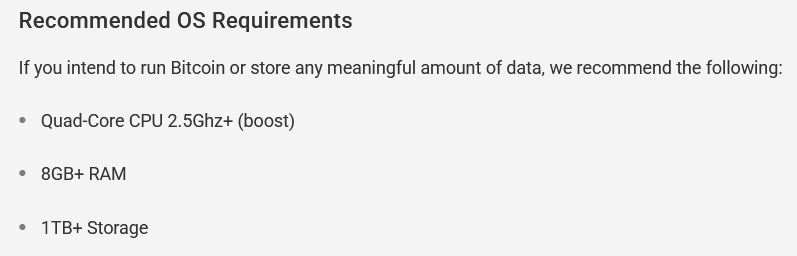
Those are the old v0351 docs.
StartOS v040 can still run Bitcoin, its probably still the most popular service on the platform. I think individual services should be responsible for explaining their own system requirements. Despite the popularity of any particular service, I don’t think StartOS Docs can list the individual requirements of 150+ services, or even know what they all are.
I found it (you could have linked to it): Installing StartOS - StartOS
I knew you thought that, but figured maybe we were past that point. Especially after you said as much. I guess not.
When did I, or anyone, even imply that to be a request, or argument, here? Answer: never once. Either you are just sidetracking intentionally, or maybe answering dialog here isn’t really your forte. If self-running a bitcoin node is what Start9 frequently mentioned, marketed, and were known for, then it should have been properly documented. My running out of storage, along with at least one other here, based on the documentation, PROVES that it was insufficient in that ONE case (not all of them, which you literally just made up yourself.)
And continues to be the case. So I’m done with this sidetracked discussion. I simply cannot recommend Start to anyone wanting to run their own DIY node moving forward, because it’s just simply too unsupported without the threat of major wasted resources.
Good day.
1 Like
Fair enough. While we love our DIY-ers. As a business that is not yet profitable, Start9’s primary focus is on issues that effect our customers. StartOS is built for, and tested on specific hardware that we sell. I expect in the future, we will have the luxury of focusing on issued outside of that scope. But we’re not there yet. In the meantime, we maintain and interact with this forum regularly. We encourage our DIY community to interact, and share information among yourselves that may be helpful in that regard.
1 Like
Personally all that would have been needed to have helped me not waste a TON of time on my DIY rig was have accurate enough minumum numbers for:
- the size the BTC node required (MORE than just the 1TB previously listed), and
- the monthly bandwidth required. Which only after the fact was the link provided to that webpage.
Why couldn’t those just be in the initial instructions?? Not the endless argument stance about “150+ services”.
That’s it. I would have made different choices and been a fan instead of just giving up and repurposing the hardware for other things now.
You guys put thousands of hours into all this, and then fumble that one at the goal-line. It’s crystal clear obvious to me. Apparently not to yall. But whatever.
I agree with you. The section in the 0.3.5.1docs you point out needs to be updated. Thank you for your follow up. I’ll see what I can do there. I don’t think the 0.4.0 docs make any such reference. As Stuart pointed out, this information probably belongs elsewhere such as the Bitcoin Core, or Bitcoin Knots package instructions. It’s obviously harder for a service like Nextcloud, or File Browser to know how much storage space you may need. But with the predictable nature of blockchain growth, I agree it’s seems reasonable that it should be mentioned somewhere. I’ll bring this up with the team. Thank you again for your input.
I would also agree that it would be reasonable for the OS to handle a full drive, in a much more graceful manner than what you experienced. If this has not already been fixed in 0.4.0, I’ll bring it up in the dev channel.
@freedom How does this info look to you? It’s accurate for today, tomorrow these might change.
This is usually the number you actually want — services cluster into a handful of real-world machines:
Types of Services
| Box | What’s on it | RAM | Drive | CPU |
|---|---|---|---|---|
| Files & passwords | Vaultwarden, File Browser, Actual Budget, Uptime Kuma, NTFY, etc. | 4GB | 128–256GB | 2-core |
| Lightning node | Bitcoin (pruned) + CLN or LND + RTL/LNbits | 16GB | 128GB | 2–4 core |
| Bitcoin explorer | Bitcoin (unpruned, txindex) + Fulcrum + Mempool (+ Am I Exposed?) | 32GB | 2TB | 4-core |
| BTCPay merchant | Bitcoin + BTCPay (NBXplorer + Postgres) + optional Lightning | 16GB | 128GB pruned / 2TB archival | 4-core |
| Mining | Bitcoin + Datum Gateway or Public Pool | 16GB | 2TB (Datum, full node) / 128GB (Public Pool, pruned OK) | 4-core |
| Photos/media | Immich, or Jellyfin + library | 16GB | 1TB+ (scales with library) | 4-core |
| Local AI | Ollama or llama.cpp + a 7–8B model (+ Open WebUI) | 16GB | 256GB | 4-core, or GPU + 16GB VRAM |
| Matrix / team chat | Synapse or Mattermost | 8GB | 256GB | 2–4 core |
| Git forge + CI | Forgejo/Gitea + its Runner | 8GB | 256GB+ | 4-core |
The Bitcoin explorer box at 32GB / 2TB is the demanding one, and it’s the “two of three — fast CPU, fast SSD, 16GB+ RAM” configuration that trips people up; erring high lands it at 32GB for the full indexed stack.
Service by Service
Device = total machine requirement (StartOS base + service + sidecars), err-high, hardware-rounded.
AI
| Service | Device RAM | CPU | Drive |
|---|---|---|---|
| llama.cpp | 8GB (small) / 16GB (7–8B) / 32GB+ | 4-core | 256GB (models) |
| Ollama | 8GB (small) / 16GB (7–8B) / 32GB+ | 4-core | 256GB (models) |
| Open WebUI | 4GB (UI only) | 2-core | 128GB |
| vLLM | 8GB sys + 16GB VRAM (GPU) / 32GB (CPU) | 4-core | 256GB+ |
Bitcoin
| Service | Device RAM | CPU | Drive |
|---|---|---|---|
| Bitcoin Core | 8GB pruned-standalone / 16GB serving | 4-core | 128GB pruned / 2TB unpruned |
| Bitcoin Knots | same as Bitcoin Core | 4-core | same |
| Bitcoin Knots (pre-RDTS) | same as Bitcoin Core | 4-core | same |
| Core Lightning | 16GB (incl. required node) | 2–4 core | 128GB (pruned node) |
| LND | 4GB (Neutrino) / 16GB (with node) | 2–4 core | 128GB / 2TB |
| Fulcrum | 8GB own → 32GB explorer box | 4-core | 256GB index → 2TB with node |
| Datum Gateway | 4GB own → 16GB with node | 4-core | 2TB (full node) |
| Public Pool | 4GB own → 16GB with node | 2–4 core | 128GB (pruned node OK) |
| Mempool | 16GB own gate → 32GB explorer box | 4-core | 256GB own → 2TB with node |
| Alby Hub | 4GB | 2-core | 128GB |
| BTCPay Server | 8GB own → 16GB with node | 4-core | 128GB pruned / 2TB archival |
| Lightning Terminal | 4GB own → 16GB with LND | 2-core | 128GB |
| LNbits | 4GB own → 16GB with node | 2-core | 128GB |
| Ride The Lightning | 4GB own → 16GB with node | 2-core | 128GB |
| Robosats | 4GB | 2-core | 128GB |
| Am I Exposed? | 4GB own → 32GB via Mempool stack | 2-core | 2TB (via Mempool→Bitcoin) |
Developer Tools
| Service | Device RAM | CPU | Drive |
|---|---|---|---|
| Forgejo | 4GB | 2-core | 128GB+ (scales w/ repos/LFS) |
| Forgejo Runner | 8GB (w/ Forgejo + jobs), unbounded under load | 4-core | 256GB+ (image cache, unbounded) |
| Gitea | 4GB | 2-core | 128GB+ (scales w/ repos/LFS) |
| Gitea Runner | 8GB (w/ Gitea + jobs), unbounded under load | 4-core | 256GB+ (image cache, unbounded) |
Files & Productivity
| Service | Device RAM | CPU | Drive |
|---|---|---|---|
| Cal.diy | 8GB | 2-core | 128GB |
| DocuSeal | 4GB | 2-core | 256GB+ (scales w/ docs) |
| File Browser | 4GB | 2-core | scales w/ your data |
| Garage | 4GB | 2-core | scales w/ stored data |
| Ghost | 8GB | 2-core | 128GB+ |
| Home Assistant | 8GB | 2–4 core | 128GB+ |
| Mattermost | 8GB (x86_64 only) | 2-core | 128GB+ |
| Nextcloud | 8GB | 2–4 core | 256GB+ / 1TB (scales w/ files) |
| NTFY | 4GB | 2-core | 128GB |
| Papra | 4GB | 2-core | 128GB+ |
| SearXNG | 4GB | 2-core | 128GB |
| Start9 Pages | 4GB | 2-core | 128GB |
| StartOS Registry | 4GB | 2-core | scales (operator-controlled) |
| Uptime Kuma | 4GB | 2-core | 128GB |
| Vaultwarden | 4GB | 2-core | 128GB |
Finance
| Service | Device RAM | CPU | Drive |
|---|---|---|---|
| Actual Budget | 4GB | 2-core | 128GB |
| Spliit | 4GB | 2-core | 128GB |
Media
| Service | Device RAM | CPU | Drive |
|---|---|---|---|
| Audiobookshelf | 4GB | 2-core | 256GB+ / 1TB (scales w/ library) |
| Immich | 16GB | 4-core | 512GB+ / 1TB (scales w/ library) |
| Jellyfin | 8GB | 4-core | scales w/ media |
| qBittorrent | 4GB | 2-core | 1TB+ (scales w/ downloads) |
Networking
| Service | Device RAM | CPU | Drive |
|---|---|---|---|
| Tor | 4GB | 2-core | 128GB |
Nostr
| Service | Device RAM | CPU | Drive |
|---|---|---|---|
| Nostr RS Relay | 4GB | 2-core | 128GB+ (scales w/ events) |
| Primal | 4GB | 2-core | 128GB |
Social
| Service | Device RAM | CPU | Drive |
|---|---|---|---|
| Jitsi Meet | 8GB idle / 16GB multi-party | 4-core | 128GB |
| OwnTracks Recorder | 4GB | 2-core | 128GB |
| SimpleX Server | 4GB | 2-core | 128GB |
| Synapse | 8GB | 2–4 core | 256GB+ |